
As product designs become increasingly complex and industry standards demand tighter tolerances, manufacturing professionals frequently face a fundamental choice: should they stick with traditional 3-axis CNC machining, or upgrade to the advanced capabilities of 5-axis CNC machining? Both technologies play vital roles in modern production, but they serve entirely different purposes, budgets, and engineering requirements.
This comprehensive guide explores the definitions, core differences, technical advantages, and ideal application scenarios for both 3-axis and 5-axis CNC systems to help you determine which one your business truly needs.
What Is a 3-Axis CNC Machining?

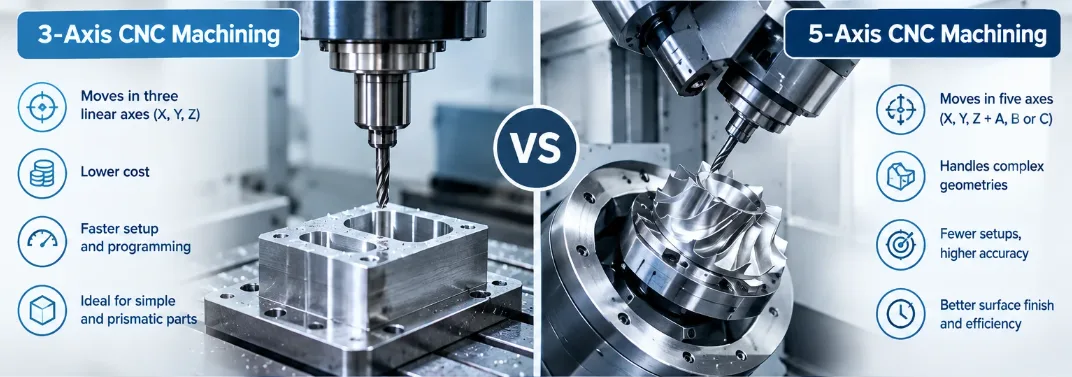
A 3-axis machine operates along three linear axes—X (lateral movement), Y (longitudinal movement), and Z (vertical movement). Throughout the machining process, the cutting tool remains fixed in a vertical orientation relative to the worktable (or perpendicular to it). The workpiece moves or the spindle travels along these three straight lines, meaning the tool cannot tilt or angle itself relative to the part.
What Is a 5-Axis CNC Machining?

A 5-axis machine builds upon the foundation of the three linear axes (X, Y, and Z) by adding two rotational axes—typically A and B (tilting and rotating the table) or B and C (tilting and rotating the spindle head). This configuration allows the cutting tool to approach the workpiece from virtually any spatial angle, enabling the creation of intricate geometries and complex 3D contours in a single continuous setup.
Core Differences Between 3-Axis and 5-Axis CNC Machining
1. Tool Approach Angle and Accessibility
- 3-Axis CNC Machining: Because the tool direction is entirely fixed, machining is restricted to the top surface or predetermined lateral directions. Deep cavities, steep walls, and undercuts are virtually impossible to reach efficiently without specialized custom tooling or manual repositioning.
- 5-Axis CNC Machining: The ability to tilt and rotate means the cutting tool can always maintain an optimal perpendicular or angled approach relative to the machining surface. This flexibility avoids tool interference, allows shorter and more rigid cutting tools to be used, and provides unobstructed access to deep recesses and complex undercuts.
2. Number of Setups Required
- 3-Axis CNC Machining: Machining a component that features geometric traits on four or more sides typically requires 4 to 6 separate setups and re-fixtures. Every single time a part is flipped or remounted, operators must perform manual alignment and edge-finding.
- 5-Axis CNC Machining: Multi-sided features can be completely machined in a single setup (or at most two setups). This eliminates repeated alignment errors, drastically cuts down non-cutting auxiliary time, and accelerates overall shop floor throughput.
3. Printable/Machinable Geometry Types
- 3-Axis CNC Machining: Excellent for planar surfaces, straight slots, standard holes, basic 2.5D contours, and relatively flat 3D sculptured surfaces.
- 5-Axis CNC Machining: Unlocks advanced geometries such as undercuts, deep cavities with thin walls, complex freeform surfaces, twisted turbine blades, impellers, and multi-angled cross-holes that 3-axis routers simply cannot fabricate reliably.
4. Precision and Surface Finish
- 3-Axis CNC Machining: Frequent re-clamping inevitably introduces cumulative positioning errors—a combination of fixture wear, manual alignment inaccuracies, and machine thermal growth. Final dimensional accuracy depends heavily on operator skill and the number of interventions.
- 5-Axis CNC Machining: Single-setup machining eliminates cumulative fixture errors. Furthermore, because the cutting tool can be held at an optimal angle, constant chip loads and superior surface roughness—frequently reaching Ra 0.4 to 0.8 µm—can be achieved, often getting close to traditional grinding finishes.
Detailed Comparison: 3-Axis vs 5-Axis CNC Machining
|
Feature / Metric |
3-Axis CNC Machining |
5-Axis CNC Machining |
|
Linear Axes |
3 (X, Y, Z) |
3 (X, Y, Z) |
|
Rotational Axes |
None |
2 (A/B or B/C) |
|
Typical Setups |
High (Multiple fixtures/flips) |
Low (1 to 2 setups) |
|
Surface Finish (Ra) |
Moderate (1.6 to 3.2 µm typical) |
Superior (0.4 to 0.8 µm) |
|
Tool Length Requirements |
Longer tools often needed to reach deep areas |
Shorter, more rigid tools can be used |
|
Programming Complexity |
Moderate (Standard CAM programming) |
High (Advanced 5-axis simultaneous CAM) |
|
Initial Capital Investment |
Lower, accessible for startup shops |
High, requires specialized machinery & software |
When to Choose 3-Axis vs 5-Axis CNC Machining?
Choosing between these two manufacturing approaches depends on your project requirements, volume, material costs, and long-term business goals.
When to Choose 3-Axis CNC Machining:
- Simple Part Geometries: Your parts feature straightforward shapes, flat faces, or standard prismatic features requiring only single-side or dual-side processing.
- Relaxed Tolerances: Dimensional tolerances are relatively loose (greater than ±0.05 mm), reducing the need for ultra-high-precision setups.
- Budget-Conscious Startups: Your business is in its initial growth phase, capital is limited, or current order volumes do not justify the high investment cost of a 5-axis machine.
- Stable Product Lines: You manufacture mature products with stable designs that do not require complex multi-axis geometric updates in the near future.
When to Choose 5-Axis CNC Machining:
- Complex Multi-Sided Components: Parts require machining across four or more sides, or contain intricate 3D contours, deep pockets, and complex undercuts.
- Strict Tolerance Demands: Tight engineering tolerances (less than ±0.02 mm) and exceptional surface finish requirements are mandatory.
- High-Value Materials: You are machining expensive, difficult-to-cut aerospace and industrial alloys (such as titanium, Inconel, and high-nickel stainless steels) where material waste and scrap parts carry a massive financial penalty.
- Competitive Differentiation: Your business targets high-value, high-margin industrial sectors where advanced manufacturing capabilities establish a strong technical barrier against competitors.
Conclusion
Deciding whether to utilize 3-axis or 5-axis CNC machining depends entirely on your project’s unique production requirements, geometric complexity, and budget. There is no absolute superiority between the two technologies; each serves a specific manufacturing niche.

At Hongwen CNC, we specialize in bridging the gap between design and high-performance manufacturing by offering both advanced 3-axis and state-of-the-art 5-axis CNC machining services.
- Comprehensive Capabilities: Whether you need cost-effective single-side milling for standard parts or complex, multi-sided contouring for high-precision components, our versatile facility adapts to your exact specifications.
- Uncompromising Precision: Equipped with advanced machinery, we ensure strict tolerance compliance and exceptional surface finishes tailored to your industry standards.
- Engineering Expertise: Our experienced technical team helps you optimize your design for manufacturing (DFM), reducing lead times and material waste whether you choose a 3-axis or 5-axis workflow.
Ready to bring your industrial designs to life with the optimal manufacturing setup?
Contact Hongwen CNC today to discuss your project requirements and discover how our custom machining solutions can drive your business forward.